9 Phone Farm Services for TikTok and Instagram, Compared
Compare managed phone farms, cloud phones, and self-hosted options by device type, pricing, countries, content, API access, and operator burden.
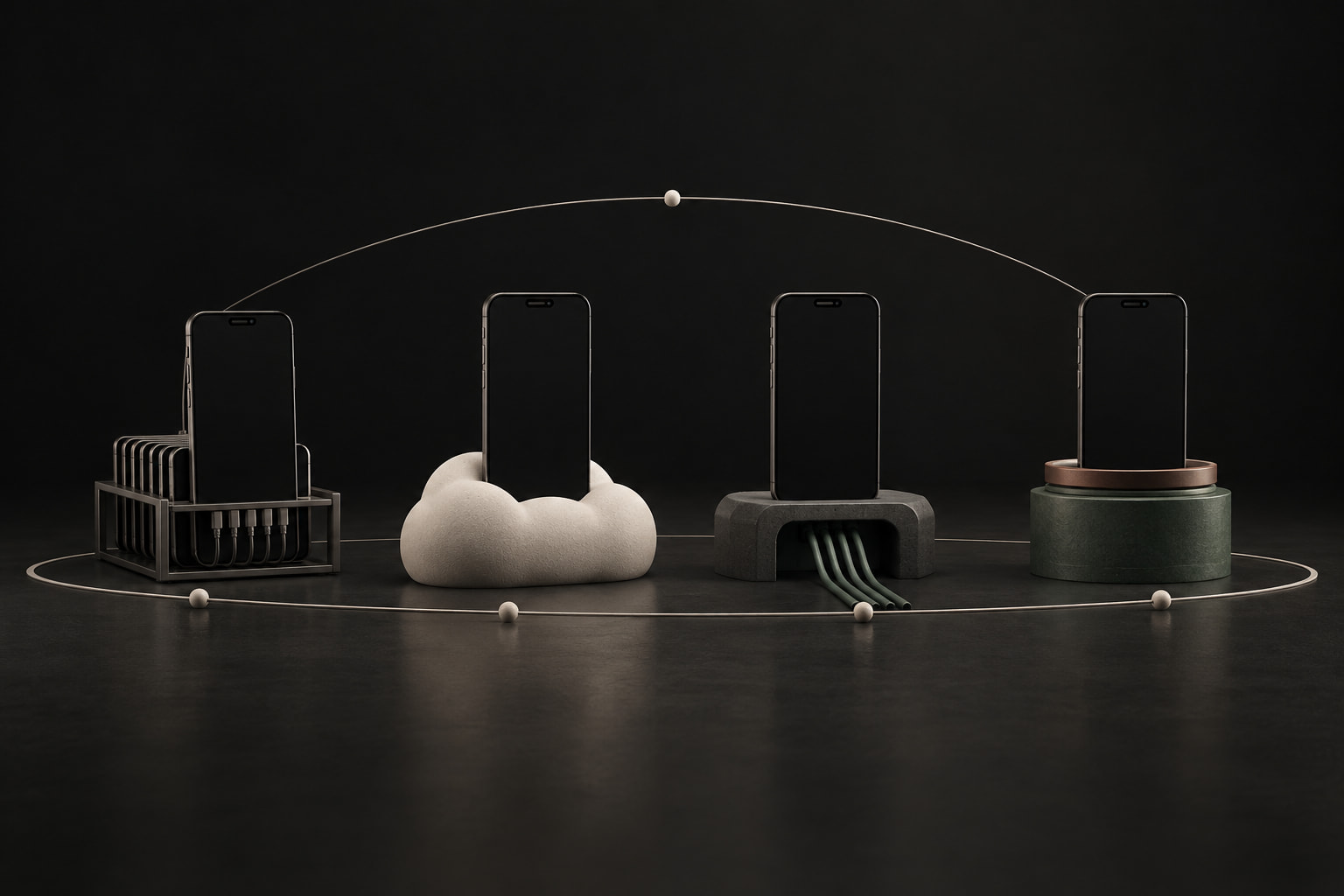
A phone farm service gives you smartphones or mobile environments to run TikTok and Instagram at scale. Some providers operate physical phones; others rent cloud Android profiles or sell software for phones you own. Doublespeed hosts each account on a real US phone for $150 per account per month (10-account minimum), with about 7 days of warming and no fake likes or comments.
TL;DR
- Choose a managed phone farm service when you need real devices without owning the hardware or staffing daily device operations.
- Compare the delivery model before the price. A managed physical phone, a cloud Android profile, and software for your own phones are different products.
- Published prices currently range from low-cost software and metered cloud phones to $150 per account per month for a managed US device slot, and from $700 per month for managed multi-account distribution that includes engagement. Content production may cost extra or be included.
What is a phone farm service?
A phone farm service provides access to smartphones or mobile environments that can run social media workflows at scale. Some providers supply and operate physical phones. Others rent cloud Android profiles or sell software for phones you own. The right choice depends on geography, native-app requirements, content volume, account ownership, and how much operational work your team can absorb.
This comparison focuses on TikTok and Instagram workflows. It does not assume that real-device posting is always better than an official API. TikTok's Content Posting API supports direct publishing and draft uploads. A device-based workflow is useful when the work must happen inside the native app or when a team needs a managed device layer.
Which phone farm services should you compare?
| Service | Delivery model | Hardware | Content included | Public pricing checked September 2026 |
|---|---|---|---|---|
| Doublespeed | Managed US account slots | Real US phones | Optional | $150/account/month; Content Agent $250/account/month |
| Conbersa | Managed multi-account distribution | Real phones with carrier SIMs | Posting + engagement handled | From $700/month for 5 TikTok accounts |
| TokPortal | Managed accounts and local operations | Real phones with local operators | No | From $49/month; credit based |
| GenFarmer | Hardware and automation you operate | Box Phone farms and cloud phones | No | Hardware + software; cloud phones available |
| iRemotech | Remote dedicated iPhones | Real iPhones | No | $50/device/month base |
| GeeLark | Self-operated cloud Android | Cloud phones | No | $0.007/minute or $29.90/device/month |
| Multilogin | Cloud mobile and browser profiles | Cloud Android plus browser profiles | No | Free plan; paid plans from $7.08/month annually |
| TikMatrix | Software for a self-hosted fleet | Your Android phones | No | $29 to $149/month per PC |
| Build your own | Hardware and control stack you own | Your phones | No | No standard price; calculate full TCO |
The table is not a quality ranking. It normalizes the first question a buyer should ask: what is being delivered? Vendor claims, capacity, country availability, and prices can change, so recheck each source before signing a contract.
1. Doublespeed
Doublespeed combines real-device posting in the United States with an optional content layer. It is distribution only: Doublespeed does not sell fake likes or comments.
The Hosted Account Slot costs $150 per account per month, with a 10-account minimum. It provides a dedicated slot on a real US device, US device traffic and posting, account warming of about 7 days, default pace up to 2 TikTok posts per account per day, and access to Doublespeed's bulk creation suite. The customer supplies the content.
The Content Agent costs $250 per account per month and is in research preview. It adds planning, content generation, scheduling, review links, and a feedback loop based on account performance. The Managed Service is scoped on a call and adds a strategist, editing team, and twice-daily posting.
Best fit: teams targeting US audiences that want device operations handled for them, especially when content production is also a bottleneck.
Check before buying: supported social platforms, account ownership (eligible for transfer after 3 months per Doublespeed docs), approval workflow, security controls, and whether the campaign needs a country other than the United States.
Source: Doublespeed product and pricing.
2. Conbersa
Conbersa sells managed multi-account distribution on real phones with carrier SIMs. Its public infrastructure page lists plans from $700 per month for 5 real-device TikTok accounts, with posting and engagement (likes, comments, shares) handled by Conbersa, plus a 7-day account warmup. A higher tier starts at $1,000 per month for 10 TikTok accounts. Instagram Reels, YouTube Shorts, and Facebook Reels can be added for a flat per-platform fee.
This is a different product shape from Doublespeed's Hosted Account Slot. Conbersa bundles posting plus engagement on your behalf. Doublespeed's hosted slot is distribution on a real US phone without manufactured likes or comments; content is optional via Content Agent or Managed Service.
Best fit: teams that want a done-for-you posting and engagement layer on real devices and are comfortable with Conbersa's engagement model.
Check before buying: what “engagement” means in the contract, account ownership and exit terms, which countries are available, and whether AI-generated or branded-content disclosures are handled in the workflow.
Source: Conbersa infrastructure.
3. TokPortal
TokPortal provides account creation, publishing, warming, analytics, and automation through a dashboard, REST API, MCP server, SDKs, and webhooks. Its public site says it uses real devices and local operators across 20 countries, subject to operator capacity.
Pricing is credit based. TokPortal currently lists plans from $49 per month. Its public pricing explanation says account creation costs 32 credits, publishing a video costs 2, advanced warming costs 5 credits per target with a 15-credit minimum, and ongoing account management costs 25 credits every 30 days after the included first month.
Best fit: multi-country distribution where local account operations and programmatic access matter.
Check before buying: the credit cost of your expected posting cadence, current capacity in the target country, and which analytics are included at your plan level.
Source: TokPortal.
4. GenFarmer
GenFarmer sells phone-farm hardware and automation for teams that want to build and operate their own fleet. Public materials describe Box Phone farm units with integrated power, cooling, and USB ports, GenRouter proxy routers for SIM-based IPs, no-code automation software, and cloud-phone options for teams that prefer elastic Android environments over shelving.
This is infrastructure and software you operate, not a managed US account slot. Compare GenFarmer with TikMatrix and “build your own” when the team already has (or will hire) device operators.
Best fit: operators who want packaged hardware plus automation control and are prepared to own day-to-day fleet maintenance.
Check before buying: total hardware quote for the required fleet size, cloud-phone runtime pricing if used, automation maintenance burden, and geography of SIM and network exits.
Source: GenFarmer TikTok phone farm guide.
5. iRemotech
iRemotech rents remote access to dedicated physical iPhones. Its public site lists a base price of $50 per iPhone per month. Optional SIM data is $15 per month for 50 GB or $20 per month for 150 GB, with a 20 percent discount on annual base-device billing.
This is infrastructure rather than a managed content service. The customer still owns the account strategy, creative, posting logic, and most day-to-day workflow decisions.
Best fit: teams that require real iOS hardware, dedicated devices, remote access, audit logs, and role-based controls.
Check before buying: device models, device location, SIM origin, API coverage, latency from your operators' locations, and replacement terms.
Source: iRemotech.
6. GeeLark
GeeLark provides cloud Android profiles rather than phones on a shelf. Profiles can be created quickly and operated remotely, with proxy management, automation, API access on paid plans, and team controls.
Cloud phone runtime costs $0.007 per minute by default. GeeLark also lists monthly rental at $29.90 per device and parallel capacity at $39.90 per parallel session per month. Its plan selector changes with profile count, so the final subscription price should be calculated for the required fleet size.
Best fit: teams that need elastic Android environments and can run their own account and content operations.
Check before buying: total runtime minutes, concurrent sessions, profile count, proxy costs, and whether a cloud Android environment meets the campaign's geography requirements.
Source: GeeLark pricing.
7. Multilogin
Multilogin combines browser profiles, built-in proxies, and cloud mobile profiles. Its free plan includes five profiles and one cloud mobile profile with 30 minutes. Paid plans start at $7.08 per month when billed annually, with higher profile limits, mobile minutes, automation features, and team controls.
This product spans two categories. Browser profiles are useful for browser-based account work. Cloud mobile profiles are relevant when the workflow must run in an Android app. Neither should be described as a managed physical phone farm.
Best fit: teams that want browser and cloud-mobile profile management in one product.
Check before buying: how many cloud mobile minutes are included, whether the task is browser-first or app-first, and whether API access is available at the selected tier.
Source: Multilogin pricing.
8. TikMatrix
TikMatrix is desktop software for operating Android devices over ADB. It does not supply phones, accounts, proxies, SIMs, or operators. The free tier includes basic device management without automation. Paid automation plans cost $29 per month for 5 concurrent devices, $59 for 20, $99 for 50, and $149 for 100, licensed per PC.
Best fit: teams that already own Android hardware and have a named operator responsible for the fleet.
Check before buying: the cost of phones, hubs, networking, proxies, maintenance, replacement devices, and operator time. The software price is only one line in the total cost.
Source: TikMatrix documentation.
9. Build your own phone farm
A self-built phone farm gives the team full control over device models, geography, networking, software, and security. It also makes the team responsible for hardware failures, battery health, cooling, SIM administration, automation maintenance, access control, and account recovery.
The purchase price of the phones is not the total cost. Use the phone farm cost and build-vs-rent model to calculate annual hardware depreciation, replacements, connectivity, power, software, facilities, and labor before comparing a self-hosted fleet with a rental quote.
Best fit: teams with stable demand, unusual requirements, and an existing device-operations function.
How should you choose a phone farm service?
Start with the operating requirement, then compare cost.
- Decide whether native-app execution is required. If the official TikTok or Instagram publishing path meets the need, an API scheduler may be simpler.
- Specify the substrate. Write down whether the campaign needs physical Android phones, physical iPhones, cloud Android, or browser profiles.
- Specify geography. Device location, SIM origin, carrier context, and proxy location are separate facts. Ask for each one.
- Define account ownership. Confirm who controls credentials, who owns the accounts, and what is transferred at cancellation.
- Calculate the complete unit cost. Include content, account management, warm-up, posting, analytics, operator labor, and replacement capacity.
- Review security and compliance. Ask about credential storage, client isolation, audit logs, incident history, commercial-content disclosure, and account recovery.
- Run a measured pilot. Set success criteria for uptime, posting success, turnaround time, content quality, and attributable business outcomes.
For the full buying process, use the phone farm provider checklist.
Are phone farms allowed by TikTok and Instagram?
The hardware itself is not prohibited. The behavior matters. TikTok's guidelines prohibit spam such as using automation to run many accounts or send repetitive content, and they prohibit tools designed to bypass platform systems. TikTok also provides an official Content Posting API for approved direct posting and draft-upload workflows.
Commercial content creates a separate disclosure obligation. The FTC says an endorsement should make a material connection to the brand obvious. TikTok's Direct Post API also includes fields for branded content and AI-generated content. A provider should be able to explain how those requirements are handled in its workflow.
Sources: TikTok Community Guidelines, TikTok Content Posting API, and FTC disclosure guidance.
What is a phone farm service?
A phone farm service provides remote mobile capacity for operating accounts or workflows at scale. The service may use physical phones, cloud Android profiles, or software connected to customer-owned phones. Buyers should verify the substrate instead of relying on the label.
How much does a phone farm service cost?
There is no single market rate because the billing units differ. Current public prices include $0.007 per cloud-phone minute, $29 to $149 per PC for self-hosted automation software, $50 per dedicated iPhone per month, $150 per managed US account slot per month, and from $700 per month for managed multi-account distribution that includes engagement. Compare the same scope of hardware, operations, content, and posting volume.
Do phone farm services include content creation?
Most infrastructure and distribution products do not. Doublespeed's Content Agent and Managed Service include a content layer, while its Hosted Account Slot and the other infrastructure options in this guide expect the customer to supply content. Conbersa's public plans include posting and engagement handled by the provider.
Is a cloud phone the same as a physical phone farm?
No. A cloud phone is a remotely hosted Android environment. A physical phone farm uses handsets. Both can run mobile apps, but hardware, SIM, location, sensor, replacement, and operating characteristics differ.
Does Doublespeed use real phones or emulators?
Real phones. Doublespeed hosts each TikTok account on a real US phone with a dedicated slot, US device traffic, and about 7 days of in-house warming before posting. It does not sell fake likes or comments.
Is a phone farm necessary for TikTok automation?
Not always. TikTok's Content Posting API supports approved direct posting and draft uploads. A phone farm or managed real-device slot matters when the workflow must run inside the native app or when the team needs managed device identity. Cloud phones and self-hosted controllers are other substrates with different risk and cost profiles.
Who owns the accounts after three months on Doublespeed?
Per Doublespeed docs, eligible accounts can be transferred after 3 months. Confirm credential ownership, recovery methods, and export terms in writing before you buy any provider.
How long should you warm a new TikTok account?
Industry guidance commonly cites 7 to 14 days of light native-app activity before posting. Doublespeed's default is about 7 days on the real device. See How to warm a TikTok account.
Related reading
Source and update policy
Pricing and product details were checked against vendor-controlled pages on September 7–10, 2026. This comparison should be reviewed at least quarterly and whenever a vendor changes its pricing or delivery model. Doublespeed's own listing is disclosed and should be held to the same verification standard as every competitor.